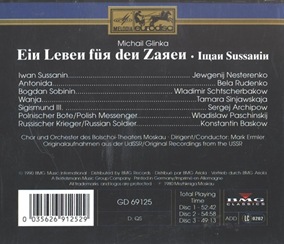
One of the main attractions in this recording of Mikhail Glinka’s Ivan Susanin is the singing of Vladimir Shcherbakov. a tenor new to me, with a fine heroic ring to his voice and an ability to sail with ease up into the high register favored in his part. Nesterenko is his usual immensely impressive self, particularly in Act 4. At her first appearance Sinyavskaya shows a rather pronounced vibrato, but she is a good artist, even if her voice—a fruity contralto of the old-fashioned type—never for a moment suggests that of a boy. The shrill harshness of Bela Rudenko here, obviously ill at ease on her high notes in her Act I cavatina, is far from precise in the Act 3 quartet. It is inexplicable that the Russians seem to thrill to these razor-edge sopranos.
 The chorus, which has Act 1 virtually to itself, is vigorous but somewhat rough-and-ready in places and in the finale to Act 2 it entirely disregards the marked tonal nuances. The Second Act, with its unbroken sequence of Polish dances, is an orchestral showcase, and the Bolshoi orchestra, here as elsewhere, shows itself very much on home ground; but it is curious that, exactly as in the Markevitch performance, the trumpets' entry in the Krakowiak should be out of tune. Mark Ermler gives the Valse much grace, keeping the pace very restrained; but I was surprised by his very slow speed for the Allegro conspirito orchestral epilogue to Vanya's solo in the last act; and here and there the synchronization between chorus and orchestra could have been more exact. The recording in general is good; but leaving the Kremlin bells to go on jangling after the last chord of the opera...L.S.
CD INFO
ape,scans


