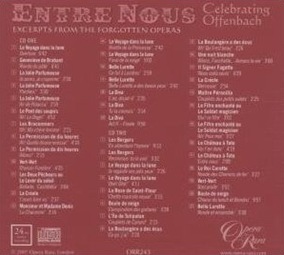
As is usually the case with this estimable record company, I have no reservation in wholeheartedly recommending Opera Rara's latest release. They have to some extent returned to their roots in Entre Nous - Celebrating Offenbach: Excerpts from the Forgotten Operas, since two of their very early recordings (Christopher Columbus and Robinson Crusoe) also captured music by the greatest composer of French comic opera ever to have lived. The recording sparkles from start to finish and makes as good a case as any for the reappraisal of Jacques Offenbach's operas, which have been unjustly neglected.
 We have an ideal marriage between intelligent programming and singers who are perfectly matched to the excerpts allotted to them. The repertoire was hand-picked by the late Patric Schmid, who was the guiding force behind Opera Rara for many years. His mixture of arias, duets and ensembles is highly imaginative, as is the mix of singers. For instance, we get an established name such as Yvonne Kenny singing with her customary warmth in Antoinette's lyrical 'J'avais bien vu' from La Créole and Caprice's 'Je regarde vos jolis yeaux' from Le Voyage dans la lune alongside a number of outstanding contributions from the up and coming young tenor Colin Lee. Each of the two CDs has the shape of an operatic act in terms of the mix of large and small scale forms - they both even end with an act finale - and the superb 240-page booklet contains texts, translations, synopses and relevant illustrations. The London Philharmonic plays responsively under David Parry's stylish conducting and there are few complaints on any front.
The life of Jacques Offenbach is fascinating. He wrote something in the order of 110 stage works and went from being an unknown to the toast of Paris - and back again, when several of his later projects were rejected. Born in Cologne into a Jewish family - his father was a Cantor in the local synagogue - Offenbach later converted to Catholicism and became a naturalised French citizen in 1860. He had his own theatre and wrote for several others; he took some of his works to foreign cities such as London, and when his operettas became less popular in the 1870s, he toured America. His masterpiece, Les Contes d'Hoffmann, was left unfinished at his death from gout and was completed posthumously by Ernest Guiraud.
Most of the music on this wonderful two-disc set upholds the view that Offenbach was the red wine to Rossini's champagne. Rossini fizzes a little more, but Offenbach is often warmer and much of his music has a very French uproarious humour that never fails to entertain.
Two tracks stand out for me as particularly amusing. First, the so-called 'Final de la neige' ('snow finale') from Le Voyage dans la lune features the performers literally trilling 'brrrr' on pitch to signify the cold they feel when it starts to snow. The excellent performers in this recording include Jennifer Larmore and Alastair Miles. Similarly entertaining is Offenbach's tribute to Johann Strauss II, whom he had encouraged to write operettas such as Die Fledermaus. The duet 'Ce fut à Londres' from Belle Lurette involves Malicorne telling Marceline how he was born by the Blue Danube, and Offenbach employs Strauss' Blue Danube Waltz as a piece of witty hommage.
There are no serious disappointments in this recording, and far too many highlights to mention them all. Some of the performers merit particular attention, however. Laura Claycomb sings a couple of taxing coloratura arias with astonishing ease; veteran Diana Montague characterises all her singing as vividly as ever; Loïc Félix's contributions are welcome for his idiomatic pronunciation of the language; and Mark Stone proves himself to be a witty Offenbachian.
One or two exposed top notes aside, this is an immaculate recording, and so much fun that you'll not want to put it down for days.--Dominic McHugh
CD INFO
Ape, covers


 one has to check who is singing. As can be seen from the track list, we are treated to a large number of the expected standard arias. Few of them have been better sung in recent times. We are also treated to several comparative rarities, which makes this an attractive buy even for those who are already well stocked with the standard stuff. When, for example, did you last hear something from Gounod’s Polyeucte or Massenet’s Le Mage and Roma? The sacred song by Berlioz is also something for the rarity list. Make no mistake: these are high quality pieces that are very likely to become friends to which you will want to return.


