Showing posts with label Mozart. Show all posts

Friday, June 24, 2011

Edda Moser - Virtuose Arien von W.A. Mozart


  • Release Date: 1988
  • Label: EMI
  • Number of discs: 1
  • Composer: W.A. Mozart 
  • Performer: Edda Moser 
  • cd info/ buy
Review:

This 1973 recital LP "Virtuoso Arias by W. A. Mozart" received the Grand Prix du Disque.

"Astonish me!" Diaghilev would cry. He should have met Miss Moser. Her singing on this album is a ballet in itself, an astonishing exercise in daring and poise; but what sets the nerves dancing in response is the sense of dramatic command and musical intelligence that accompany the virtuosity. Such a sense isEdda Moser as Queen of the night imparted right from the start. This Queen of Night makes her regal authority very  clear in her first phrases; when she tells of "den Bosenwicht" it is with some venom and when she contemplates weakness it is with scorn. Similarly, this Constanze presents an invincible spirit, and this Donna Anna a deep store of tenderness. The fluidity, the cleanness, the extensiveness of the range are all quite astounding.

01 - O Zittre Nicht, Mein Lieber Sohn (04:54)
02 - Der Holle Rache (03:04)
03 - Crudele? (07:26)
04 - Popoli Di Tessaglia (11:31)
05 - Ma Che VI Fece, O Stelle (09:17)
06 - Bester Jüngling, Mit Entzücken (03:26)
07 - Ich Bin Die Erste Sängerin (05:44)
08 - Martern Aller Arten (08:30)


flac, covers

Saturday, June 11, 2011

The Very Best of Alfredo Kraus


Review:

Alfredo Kraus remained an EMI Classics artist throughout most of his career. It is for that reason that this compilation extends from the early 1960s (two arias from Così, as conducted by Karl Böhm) up to a live recording from December 1987 ("Una furtiva lagrima" from L'Elisir d'amore and "Salut! demeure chaste et pure" from Faust). Kraus, who was born on September 24, 1927 in the Canary Islands, was 60 at the time, and hardly less of fresh of voice than he was in the Così recording. Kraus was a lyric tenor who never sounded juvenile. In lighter bel canto roles such as Ernesto (Don Pasquale) a more youthful vocal persona Alfredo Kraus as the Duke in Rigoletto at his Metropolitan Opera debut. would have been more appropriate, perhaps, but in the heavier ones, such as Edgardo (Lucia di Lammermoor) and Arturo (I puritani), Kraus's power, maturity, and masculinity were welcomed – no tenorino here. His bright, trumpeting voice and exciting high notes were tempered by a sunny suavity. On the other hand, he could be a rather bland interpreter. Given his excellence in the French repertoire, in particular, it is tempting to go as far back as Georges Thill when looking for comparisons. Kraus died in 1999.
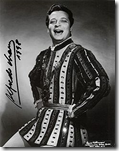
Most of these selections are taken from Kraus's complete recordings; the exceptions are the two indicated above from 1987, which were recorded at this Paris Opéra. (Frankly, it is a shame that Kraus left commercial recordings of neither L'Elisir nor Faust.) This means that Kraus is joined by excellent singers, including Montserrat Caballé in I Puritani, Renata Scotto in La bohème and La traviata, and Beverly Sills in Rigoletto and Don Pasquale. The selections have been chosen well, although, as with the other releases, there are some untidy fade-in and fade-outs. With the exception of Così, the engineering remains bright and shiny. This is an excellent compilation, and for those who are less familiar with Kraus than with the "Three Tenors," this might whet their appetite for more.


flac, scans
 

Wednesday, May 25, 2011

The Very Best of Nicolai Gedda


Review:

Hands down, Nicolai Gedda was the classiest lyric tenor of the 1950s and '60s (and very early '70s). For the most part he wisely kept away from the after-1860 Italian repertoire: his voice lacked the necessary juice, and with Björling, Bergonzi, Corelli, and del Monaco around, why bother? These CDs offer two hours and 35 minutes of singing--and interpreting--that never tire the ear and never bore.

image "Ach so fromm" is ravishing in its intimacy (by its close, it's normally shouted); Lohengrin's Narrative may lack heft, but it's a model of lyricism and Gedda darkens his tone enough to give it authority; an aria from Goldmark's The Queen of Sheba closes on an unearthly head-voiced high-C that's matched only by a similar feat in Bizet's Pearl Fishers (a performance notable for its great breath control and legato as well); Hoffman's tale of Kleinzach is a riveting, snappy story, filled with just the schizophrenia the role requires; the Dmitri/Marina duet from Boris is energetic and filled with smoldering undercurrent; three Tchaikovsky songs become little dramas; Beethoven's "Adelaide" and Schubert's "Ständchen" are models of Lieder singing; selections by Gounod and Massenet exhibit his impeccable French diction and style; the high-D at the close of Adam's "Postman" aria and repeated Cs in William Tell's would be the envy of any tenor; and his bel canto style in a duet from Sonnambula (with Mirella Freni) is ideal. Yes, this is the very best of Nicolai Gedda.--Robert Levine


flac, scans
Related Posts with Thumbnails